
The Vox T60 - design
June 2026 - in progress
For the time being, this page is effectively a series of notes posted recently on the updates page. The material will be gathered into various sections as soon as possible.
19th May
Below, the information panel of a circuit diagram - dated December 1962 - for a version of the T60 amplifier intended for use in two JMI organs. At least one of the two models in view was made for a customer, but so far as one can tell, neither the 44 nor the 55 found their way into general production.
It could be that they were two of the three new transistorised models mentioned in mid 1962. The third was certainly the Continental.
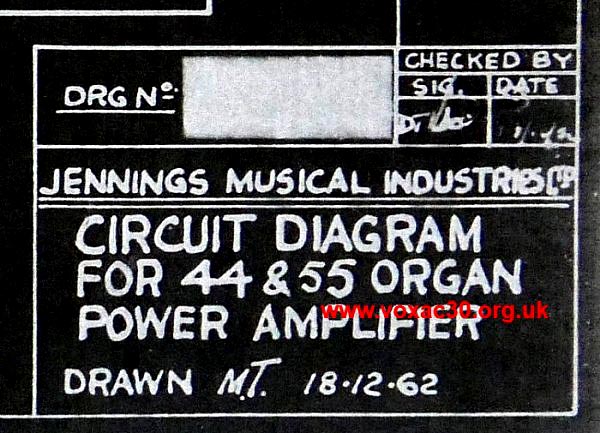
"M.T." is Mike Turner, who produced various sheets for the Continental.
20th May
Some provisional notes on the circuit diagram for the Jennings 44 and 55 organs mentioned yesterday. The power section is much the same as, though not identical to, that of the T60. The preamp is quite different: a single volume control at the input; no treble or bass controls; and an unusual negative feedback network for the output. Where the T60 had four Mullard OC44 transistors, the organ amplifier employed one OC71 and an OC72.
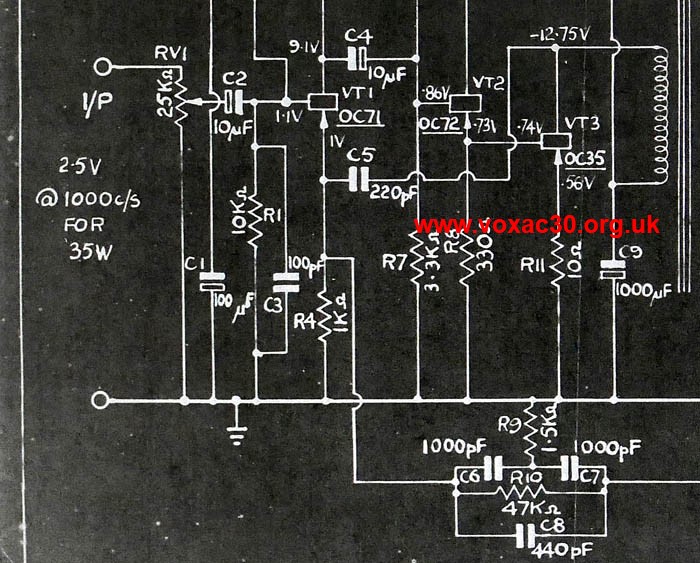
Detail of the preamp of the 44 and 55 organ amplifier. Note that the transistors are represented as oblongs - as in the earliest surviving sheet for the T60 (A62/030). T60 sheets however normally give the positions of the collector, emitter, and base, marked "c", "e", and "b". In 1963 Jennings draughtsmen adopted the standard (circular) symbol for transistors.
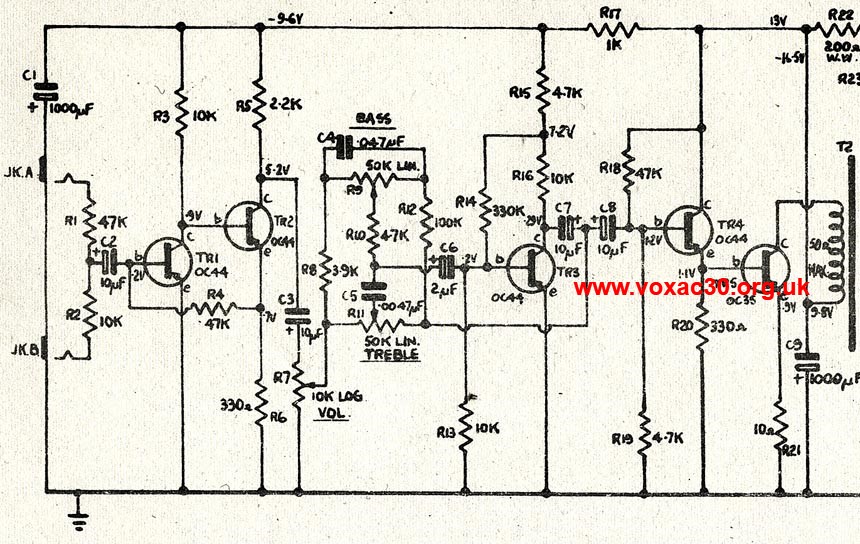
The preamp of the T60 as it stood in early 1963.
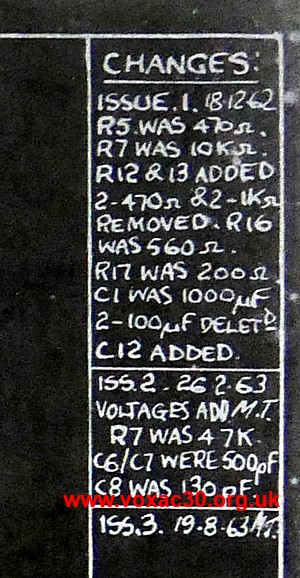
Below, the register of changes, top right of the sheet, running through to August 1963 (the date of the sheet as we have it). Most relate to the preamp. R12, R13, and C12 were present in the circuit of the T60 from October 1962 and perhaps from the outset.
23rd May
Prelim. notes on the Mullard OC35 germanium transistor, used by JMI for the T60 (and Transonic) amplifiers; the power section of the Vox Continental; and the amplifiers incorporated in the "44" and "55" organs.
The circuits in view were, in the first instance, the work of Les Hills, who had played a leading part in designing the Univox for Tom in 1951. Les reportedly rarely ventured past the front gate of his house in Belvedere, so people from JMI normally had to go to him.
Where full-time members of the Jennings R&D Department are concerned, Alan Harding had the greatest experience of working with transistors - he developed the Vox Radio Microphone system for instance - but others will naturally have contributed to the designs, not least Derek, Dick, Ken McDonnell, and Tom, who had the final say on functionality and appearance.
Working examples of all three organs, along with the T60 and Transonic, were exhibited at the Russell Hotel Trade Fair in late August 1962.
So far as one can tell, the first adverts for the Mullard OC35 appeared in early 1960. Below, the cover of the Australian edition of Mullard's "Outlook" news and technical reviews bulletin for March and April.
Initially in the UK the retail price of the device was 48 shillings - an enormous amount (November 1960). Bulk / trade prices will have been slightly less. By the summer of 1961, retail had come down to 25 shillings. Late in the year it fell further to 15 shillings, the price of a Mullard EL34.
As for data sheets, it is clear that in June 1962 Mullard circulated new, or at least fuller details in its handbooks and technical service data collections. It is to be hoped that earlier documentation can be illustrated in due course.
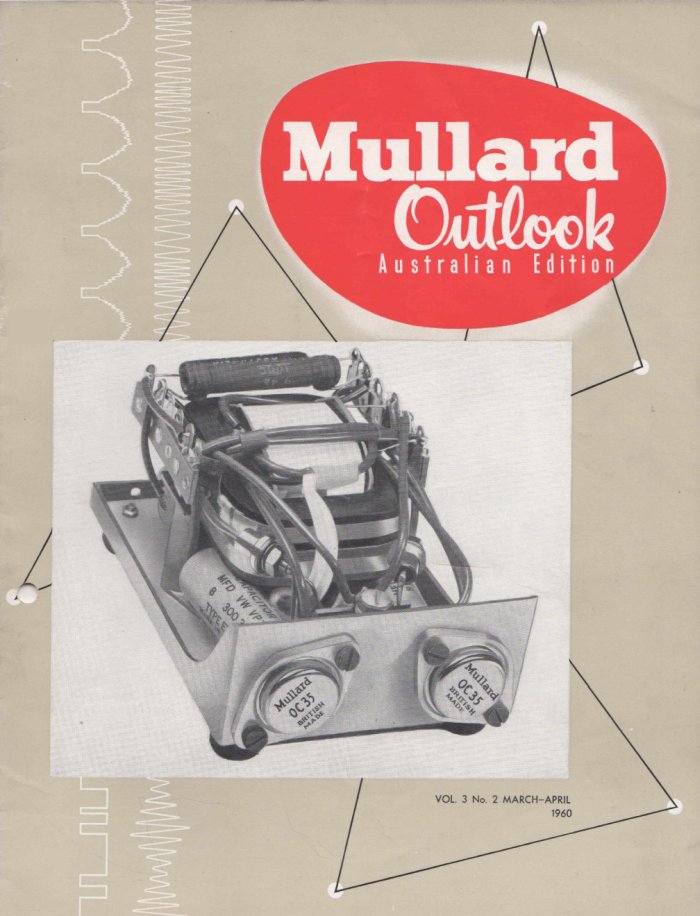
Mullard Outlook, Australian edition - image from this page.
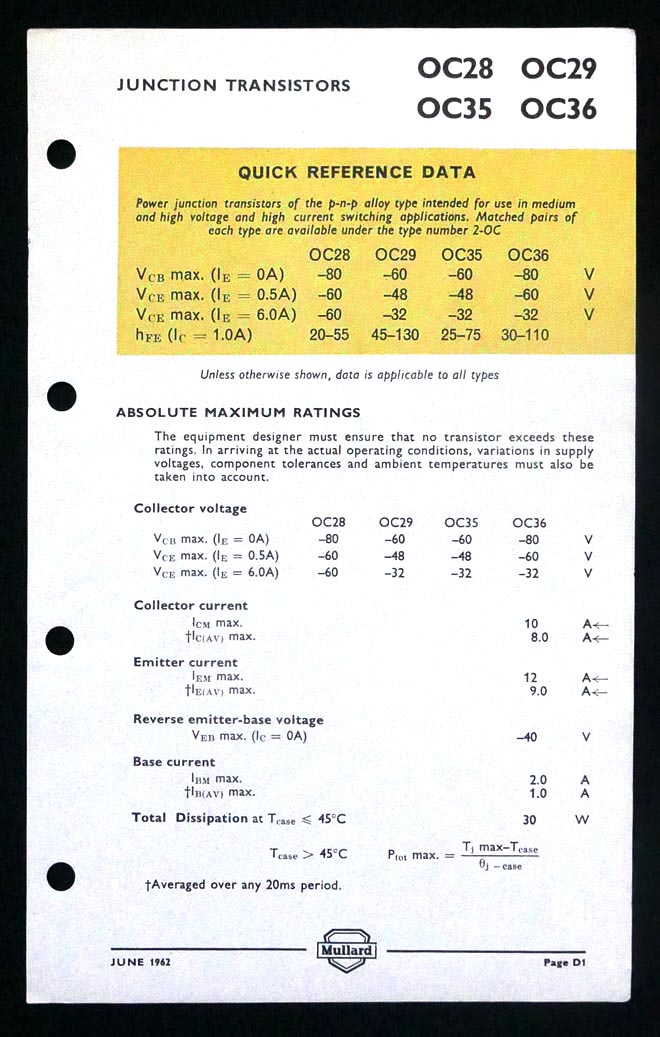
Mullard data sheet, June 1962.
30th May
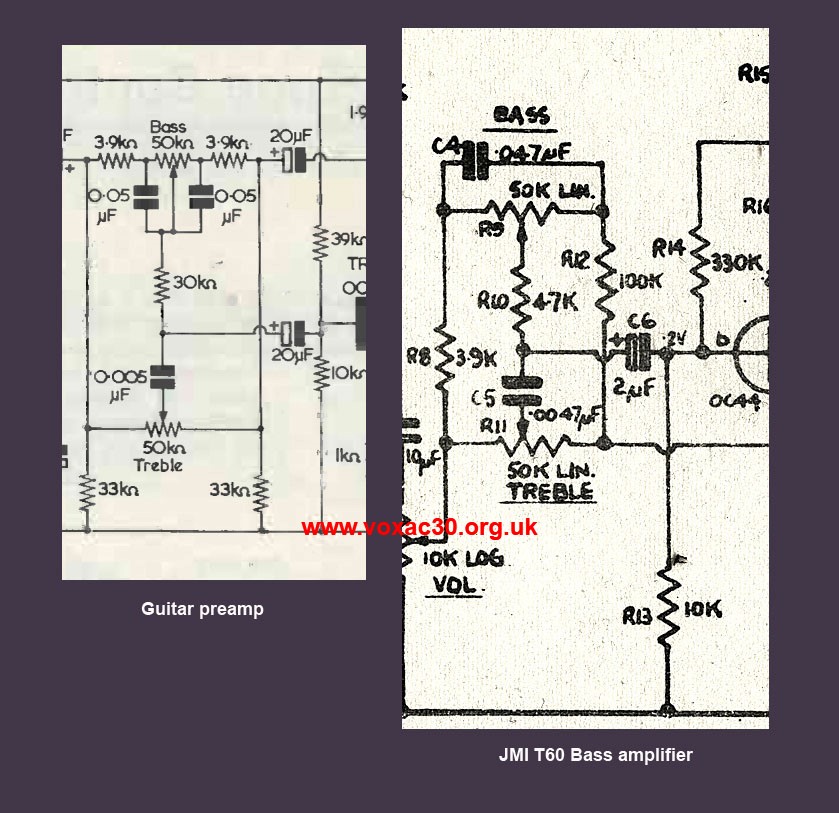
A little more on JMI's work on transistorisation in 1962. Below, a detail from a circuit for a transistorised guitar preamp published in "Radio Constructor" magazine, September, 1961, by D.E. Maynard, alongside a detail from JMI's circuit for the T60 bass amplifier (as used also in the AC30 Transonic and AC30 Lightweight amplifiers).
Allowing for necessary differences - the guitar preamp was battery-powered for instance - the arrangement of the tone controls is pretty much the same. Towards the end of his article, Maynard offered a number of modified circuits (for low-impedance input signals, etc.), one using a 10K volume pot following an initial gain stage, and 10uf coupling caps, things also present (later on) in JMI's T60.
It seems likely that Les Hills and the design team at JMI used circuits or parts of circuits such as these as their starting point. Quite what prompted the employment in the T60 - and the "44" and "55" organs - of Mullard OC35s as output transistors is not clear at the moment though.
Just to note that in 1966/1967 Triumph Electronics, one of JMI's principal contractors, brought to market a transistor preamp incorporated in a guitar strap - a neat idea. Perhaps based on Maynard's article?
1st June
Picking up from yesterday's entry, a short note on the power section of the T60/AC30 Transonic amplifiers. This stands half-way between two circuits for a Public Address amplifier published by Mullard in 1960 - one with a 14V supply and an output transformer for the speaker; the other with a 28V supply and a speaker directly coupled to the output transistors (as in the case of the T60).
A peculiarity of the JMI power section is the use of "1S021" rectifier diodes about which there is little documentation. Transistor equivalents books from the 1960s and 1970s give the BYX22 as a direct replacement. Mullard envisaged generation of the HT in its circuits from accumulators (batteries) rather than a mains transformer.
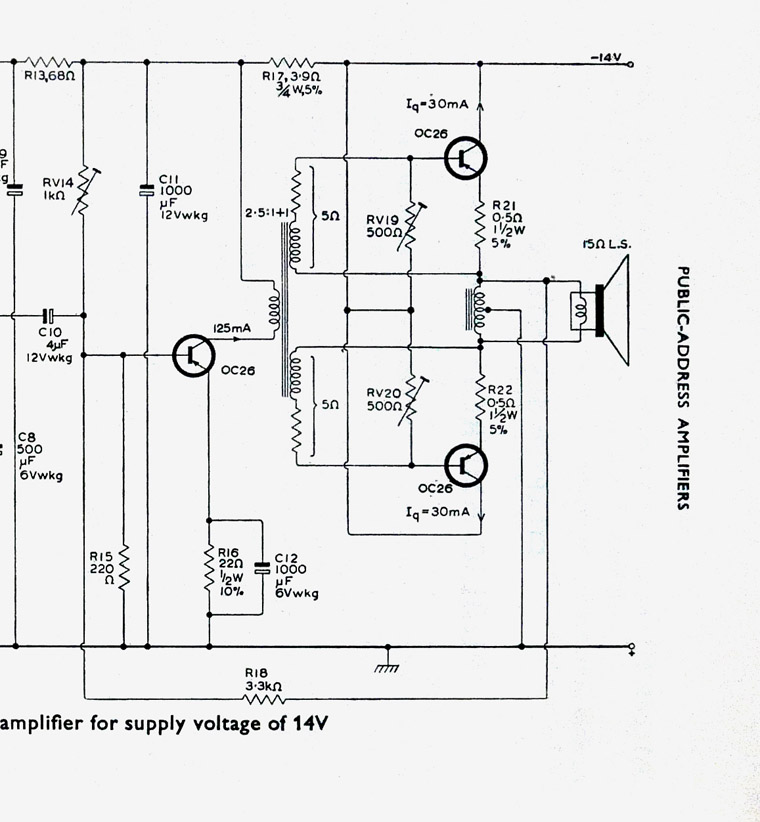
The power transistors in the T60 (OC35s rather than OC26s) are arranged as the Mullard 14V circuit (above) published in the "Reference Manual of Transistor Circuits" of 1960 and 1961; in its HT voltage and directly coupled speaker, the T60 follows the Mullard 28V design.
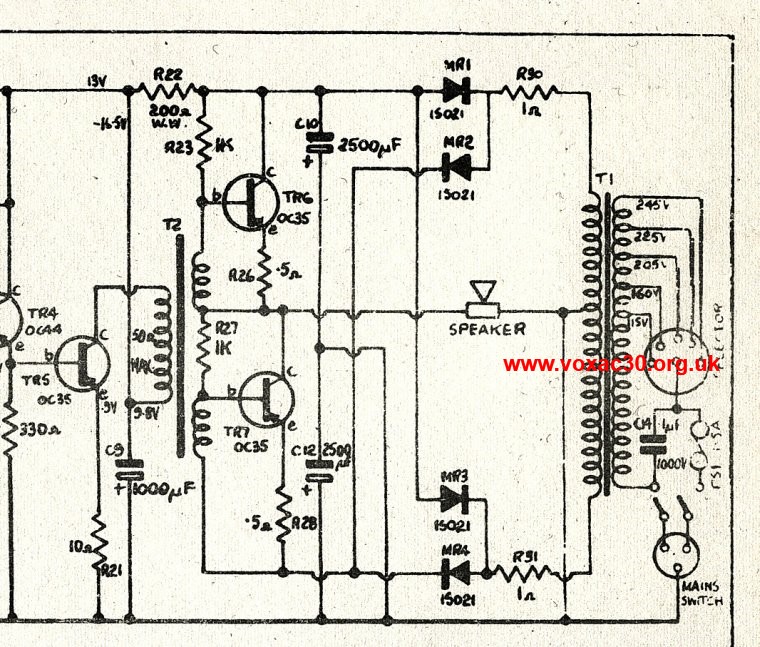
Detail of the T60 circuit of early 1963. The initial design had only two 1S021s. The manufacturer of the diodes is unknown at present.
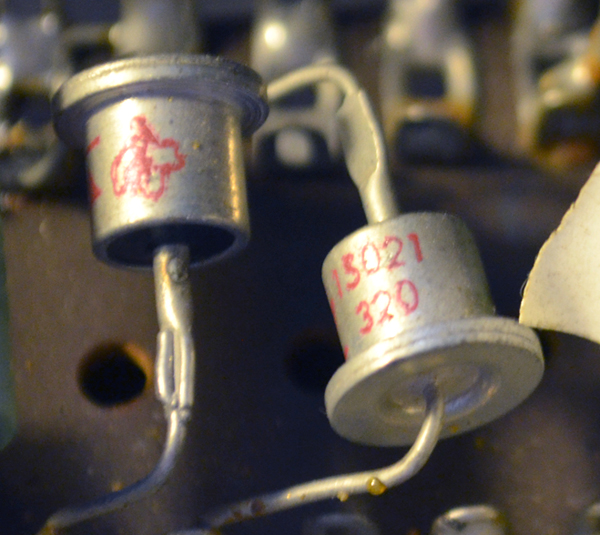
Two of the four "1S021" rectifier diodes in a T60 from the autumn of 1963.
2nd June
It turns out that the "1S021" rectifier diodes in the power section of the T60/AC30 Transonic, mentioned below, were manufactured by Texas Instruments. Texas had opened a facility in Bedford around 1960 - see this page - parictipating in various British trade shows in the early 1960s. Over the course of the T60's production (through to early 1968), Jennings used around 8000 1S201s.
So far, no earlier analogy has come to light for the use of the Mullard OC35 as an audio output transistor. Mullard recommended the OC26 and OC36. The OC35 was "general purpose", not that that can really have mattered for what was primarily a bass amplifier.
It may be that the power section of the T60 as we have it was for the most part a Jennings design (a sort of working forward from the Mullard circuit book). Whether CTH Electronics and Audix, both early to market with solid state public address amplifiers, followed Mullard to the letter is not known.
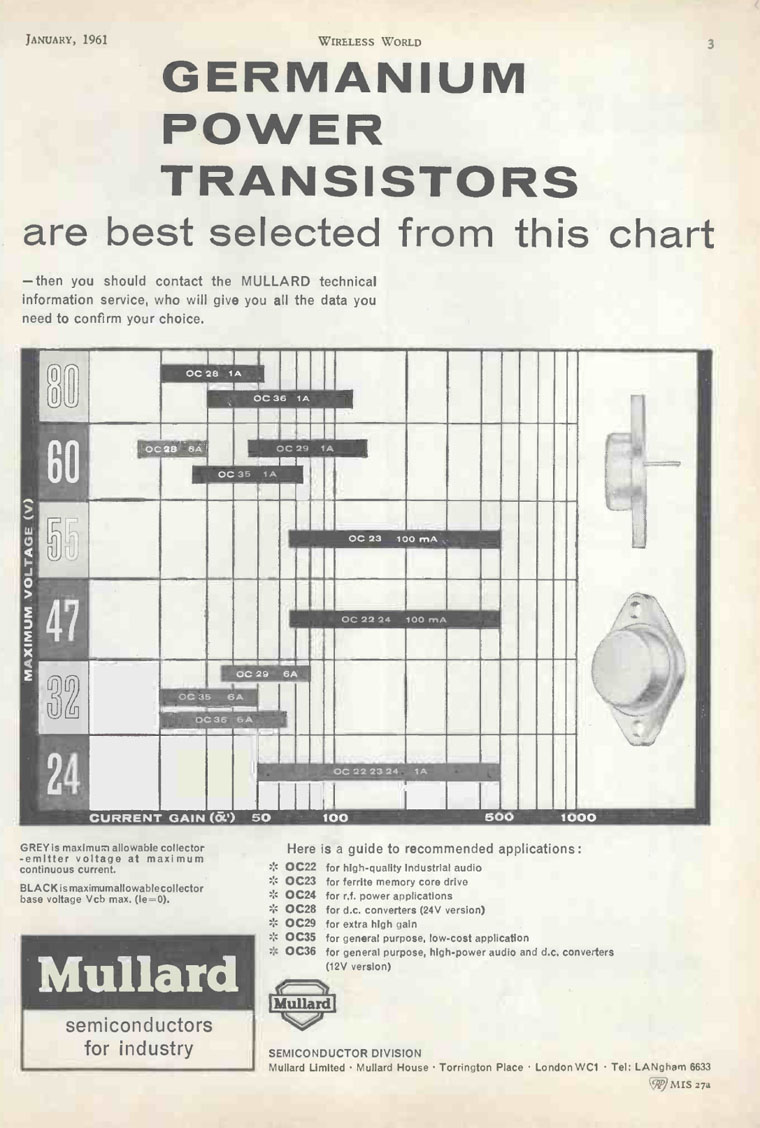
January 1961.
In later 1963, Jennings moved from the OC35 to the OC28, perhaps in the search for greater stability and consistency. Now and again, one finds OC26s. In terms of surviving T60s, the majority have - or now have - OC28s. The pincipal question marks hang over serial numbers 239 and 268 (black panel, later 1963), which have modern OC28s, possibly introduced by repairmen in line with later and more common versions of the circuit diagram. All this will be tabulated in due course.
An early Transonic amplifier section, however, does retain its original OC35s. Thanks to Steve for the picture.
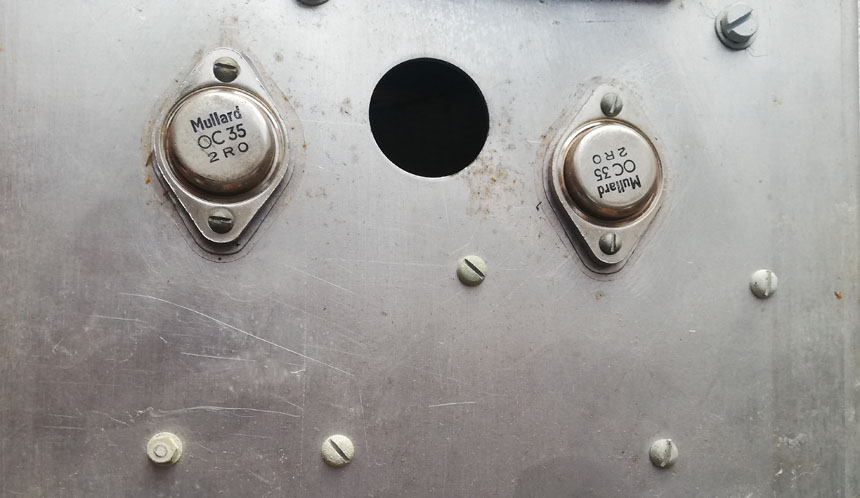
3rd June
The preamp of the T60/AC30 Transonic has three main sections: (i) an initial gain stage of two OC44s; (ii) volume, treble and bass network, based on the circuit published by Maynard in "Radio Constructor" magazine (see below, entry for 30th May); and (iii) a further two OC44s as a "gain recovery" stage before the driver transistor.
The initial gain stage (i) generally follows that of Mullard's public address amplifier (1960-1961), though Mullard envisaged OC71s, as it did for most of its other cascaded gain stage designs. Why did Jennings prefer the OC44? Hard to say for sure, but it may be that in practice its noise floor was lower than that of the OC71.
At any rate, Jennings, in a manner of speaking, stitched the preamp of the T60/AC30 Transonic together from existing elements.
Below, shots of one of the first Mullard semiconductor data booklets - from 1957 - containing sheets for 10 types of transistor and 9 diodes. The OC44 was new in December 1956, the OC71 had reached its settled form by November.
Whether the transistorised preamp/effects module developed by JMI in 1959 for its "Entertainment" organs had OC44s is unknown.
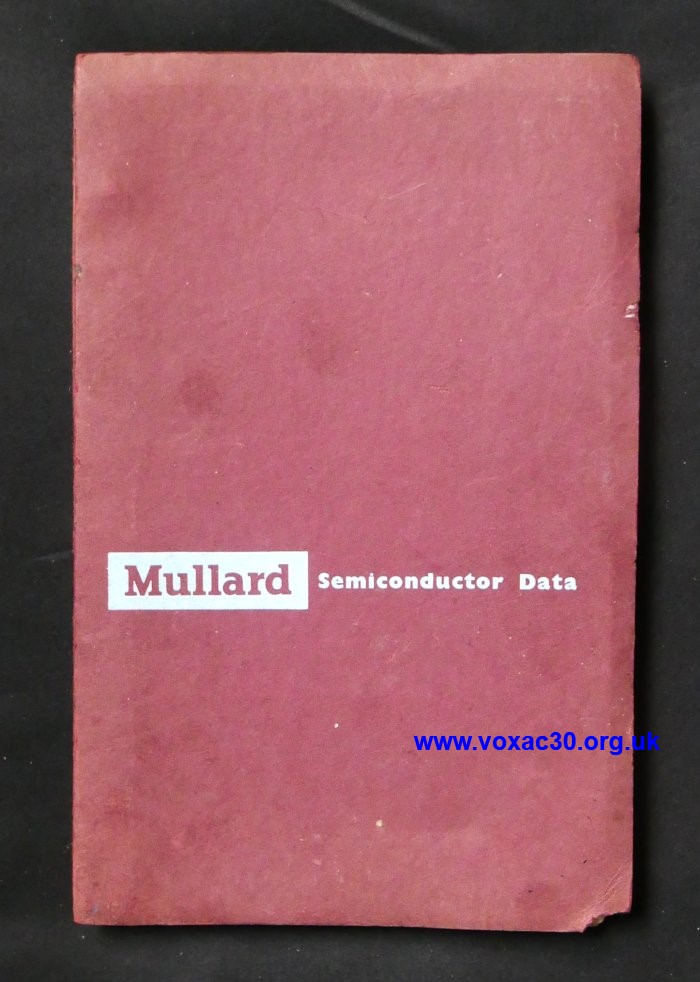
Mullard semiconductor data book, 1957.
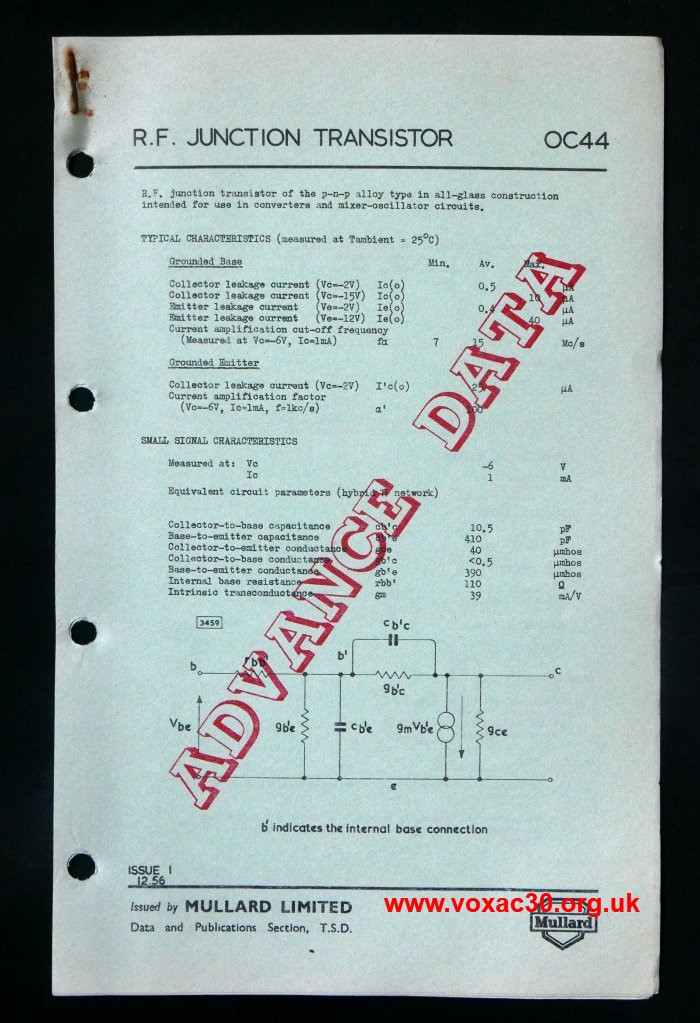
Advance pages for the OC44, December 1956..
3rd June (2)
A couple of pieces of documentation. The first, thanks to Andrew, an overview of the specifications of the Texas Instruments 1S021 diode published by Radiospares in 1965. It is probably from Radiospares that Jennings obtained its supplies, late 1962 to 1968.

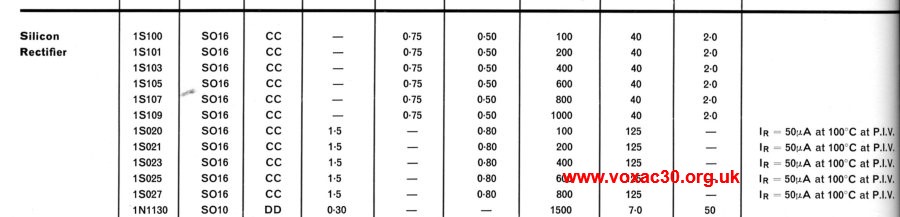
Radiospares catalogue, 1965.
The second, a sheet for the T60's circuit not much seen these days, drawn up in September 1964, presumably - as in the case of other models and their sheets - to accompany exports to Thomas Organ in the USA. A good number of T60s crossed to America in late 1964 and 1965. AC30 Transonics and Lightweights were not included in the various "deals" with Thomas.
The sheet ends with Issue 7. The two sheets most commonly seen these days take the modifications through to Issue 10 or Issue 11. Copies of one or other are often found in versions of the Thomas Organ Service Manual. To date however, no Thomas copy of the September '64 diagram has come to light. There must be one somewhere though.
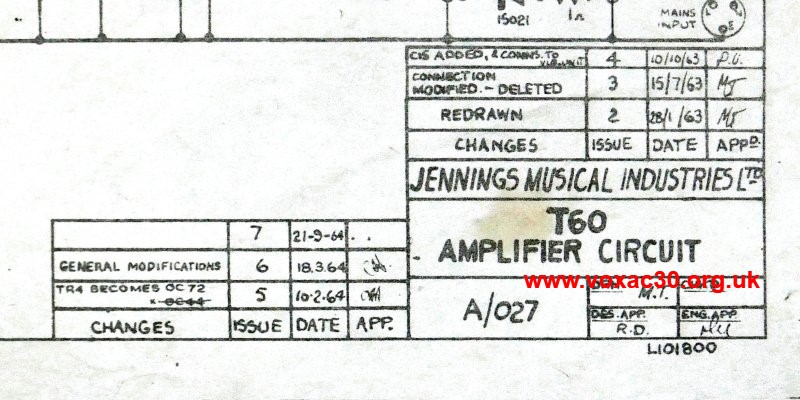
Still the earlier sheet number "A/027". Later ones were redesignated "OS/062".